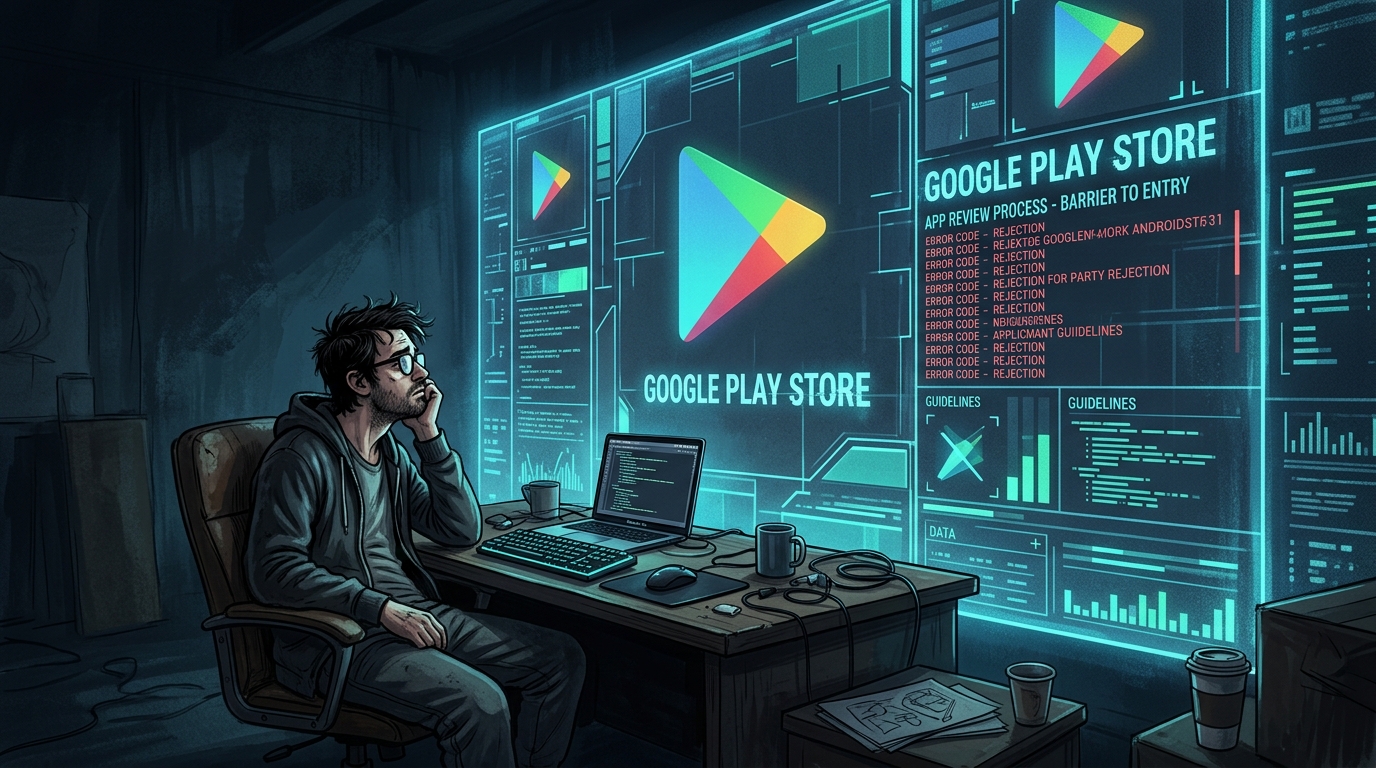
Have you ever poured months of late nights and weekend coffee into building an app? You write the code, squash the bugs, design the icon, and finally prepare to ship it to the world. You pay your $25 developer fee to Google, upload your .aab file, and then you slam face-first into a demoralizing brick wall.
Welcome to the Google Play Store in 2026.
If you are an independent developer trying to launch an Android app today, you aren't just a programmer anymore. You are a project manager, a beggar, and a social media marketer. That is because Google forces every new personal developer to jump through a massive hoop that has nothing to do with code quality and everything to do with social reach: the 14-day, 12-tester closed testing requirement.
This policy has single-handedly sucked the joy out of Android development. It was designed to stop spam and malware. Instead, it built a thriving gray market of fake testers, handed a free pass to organized scammers, and effectively killed the casual weekend project for legitimate solo creators.
Let’s talk about how we got here, why the system is broken, and why so many developers are packing up their code and walking away.
What Exactly is the 12-Tester Rule?
For anyone lucky enough to have an older Google Play account, you might have missed this entirely. If your personal account was created before November 13, 2023, you are grandfathered in. You can upload an app, pass the automated review, and go live.
But for newer personal accounts, Google dropped a bomb. Initially, they demanded that before you could even apply for production access (meaning the public could download your app), you had to recruit 20 people to opt into a closed test and keep your app installed on their devices for 14 continuous days.
The backlash was instant and furious. Finding 20 people who own Android phones, are willing to click sketchy-looking testing links, and will actually open a buggy early version of an app every single day is completely unrealistic for a solo developer building a niche tool.
In late 2024, Google quietly admitted 20 was an absurdly high bar for a single person to clear, so they lowered the requirement to 12 testers.
But changing the number didn't fix the fundamental problem. The rules are still brutal:
- You need 12 real people with real Google accounts.
- They have to officially opt-in and download the app.
- They must stay active for 14 straight days.
- Emulators do not count. Google wants real telemetry from real physical hardware.
One of the most infuriating aspects of this system is how fragile the 14-day streak is. Let's say you successfully recruit 15 people. Over the first week, three of them get bored and delete the app. You are now at exactly 12 testers. On day 13, one of your remaining testers simply uninstalls the app to free up storage space. Your tester count drops to 11.
Because of Google's strict consecutive-day requirement, your continuous streak is broken. You have to find a new 12th person, convince them to opt in, and wait for the 14-day window to rebuild. You end up constantly monitoring a dashboard, terrified that a single unengaged user is going to tank a month of your hard work.
Why Did Google Do This?
To be fair, we have to look at the massive problem Google was trying to solve. The Google Play Store was drowning in trash.
Because the barrier to entry is so incredibly low—just a one-time $25 fee—scam rings, bot farms, and malware operators treated the Play Store like a dumping ground. Bad actors would write automated scripts to pump out fifty cloned crypto-wallet scams or asset-flipped casino games in a single afternoon.
Google realized that simply verifying a developer’s identity (like checking a passport or driver's license) wasn't enough. Scammers were just paying regular people to open verified accounts, and then buying the login credentials from them. Identity verification proved a human existed, but it didn't stop a bot farm from running the account.
Google also struggles with malware evasion. Smart bad actors submit clean code that easily passes Google's automated security scanners. Then, once the app is installed on a user's phone, it acts like a sleeper agent, waiting a few days before secretly downloading malicious instructions from a remote server.
Google’s engineers designed the 14-day test as a trap. The idea was simple: force an app to sit on real devices for two weeks. If the app is malware, it will eventually execute its payload, and Google’s background telemetry will catch it before the app goes public. If the developer is a bot farm pushing out 100 apps a week, forcing them to find hundreds of human testers and wait 14 days will destroy their automated pipeline and make the process too expensive to continue.
On paper, it sounds like a brilliant piece of security engineering. In the real world, it failed spectacularly.
The Cobra Effect and the Testing Farm Gray Market
There is a famous economic concept called the Cobra Effect. The story goes that the British government wanted to reduce the population of venomous cobras in India, so they offered a cash bounty for every dead snake. In response, enterprising locals simply started breeding cobras in their basements to collect the reward. The solution actually made the original problem worse.
Google created a massive Cobra Effect.
By forcing developers to find 12 testers, Google didn't stop the scammers. They just created a completely new, unregulated gray market of fake testing services.
Within weeks of the policy rolling out, websites popped up everywhere. Services with names like PrimeTestLab or onTest now openly advertise that they will solve your Google Play problems. For about $20, these companies guarantee 12 "real" testers who will download your app and click around every day for two weeks, providing the exact telemetry Google demands. They employ click-workers or run massive physical device farms across the globe to bypass Google's anti-cheat detection.
Here is why this is a disaster:
The bad actors and organized scam rings have budgets. If a scammer expects to make thousands of dollars off a fake crypto app, paying a testing farm $20 to pass Google’s checkpoint is just a minor business expense. The spammers easily jump the hurdle.
But what about the computer science student building a free local transit tracker? What about the hobbyist making a specialized tool for their tabletop gaming group? They don't have a budget to pay a testing farm, and they don't have the social network to harass 12 friends into opening an app they don't care about every day for two weeks.
The policy acts as a reverse filter. It allows well-funded scammers to slip right through using paid services, while completely blocking honest, broke, independent developers who just want to share their code. Google turned software publishing into a popularity contest, and the solo creators are losing.
The Developer Exodus
When developers realize the game is rigged, they stop playing. We are currently seeing a massive shift in how indie developers approach mobile software, purely because they refuse to deal with this bureaucratic nightmare.
Instead of jumping through Google's hoops, developers are taking three major exit ramps:
1. The Apple Tax Looks Cheap Now
For years, Android developers mocked the Apple App Store. Apple charges a steep $99 every single year just for the privilege of keeping your apps alive on their store.
But suddenly, paying $99 to Apple feels like a bargain compared to the emotional exhaustion of the Play Store. Apple uses that yearly fee to fund actual human reviewers. When you submit an iOS app, a real person opens it, checks it for bugs, makes sure it doesn't violate guidelines, and approves it. You don't have to beg your family to test it. You just write good code, pay the fee, and launch. Many solo founders are simply pivoting to iOS first, deciding that a financial gatekeeper is much fairer than a social gatekeeper.
2. The Organization Loophole
Google’s 12-tester rule strictly applies to "Personal" developer accounts. If you register as an "Organization," the rule completely vanishes.
To get an organization account, you have to formally register a business entity with your government and obtain a free D-U-N-S number, which verifies your business identity. Rather than dealing with testing farms, many independent developers are simply registering as sole proprietors or LLCs. It requires some annoying legal paperwork up front, but it permanently bypasses the 14-day testing requirement for every app they will ever build.
3. Progressive Web Apps (PWAs)
Perhaps the most exciting shift is the move away from native app stores entirely. Progressive Web Apps have reached a point where they are functionally indistinguishable from native apps for most standard utility tools.
With a PWA, you build a web application, add a manifest file, and users can "install" it directly from their mobile browser onto their home screen.
There is no $25 Google fee. There is no $99 Apple fee. There are no app review boards rejecting your updates because a button is the wrong color. And most importantly, there is no 14-day testing requirement. When you push an update to your server, every user gets the new code instantly. For data dashboards, habit trackers, and specialized tools, developers are realizing they don't need Google's permission to put software on a user's phone.
The Death of the Weekend Project
The greatest strength of the Android ecosystem used to be its openness. It was the platform where a kid in their bedroom could build a weird, hyper-specific calculator, pay a few bucks, and share it with the world instantly. It fostered innovation by keeping the friction incredibly low.
The 14-day tester rule destroyed that environment. Google decided that offloading their quality assurance department onto the shoulders of independent developers was cheaper than hiring human reviewers. They built a wall to keep out the bots, but the bots just bought ladders, leaving the real developers stuck on the outside.
Until Google realizes that good software is defined by its code and not by a developer's ability to run a two-week social media campaign, the Play Store will continue to bleed solo talent. Independent developers aren't going to stop building great things—they are just going to stop giving them to Google.
Looking to build a premium application?
If you need a freelance developer in Sydney who understands the entire product lifecycle—from code to app store deployment—let's talk about your next project.
Hire a Freelance Developer in Sydney